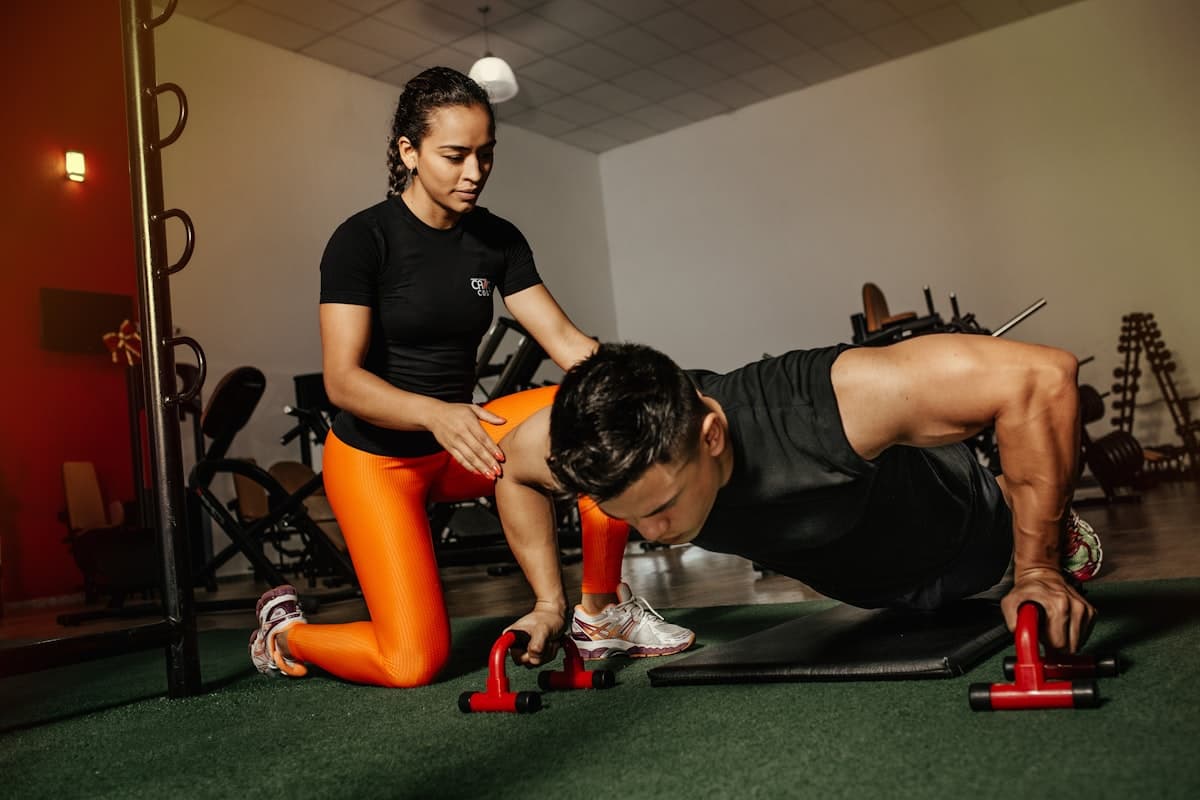
First session with a personal trainer: how to prepare and what you gain

Your first session with a personal trainer is not a job interview. It is the foundation of a plan that will guide you for weeks to come. How you prepare decides whether you walk out of the studio with a clear direction — or with vague advice and wasted time. The good news: preparation takes less than two hours, and the difference shows up in your first workout. In Polish studios, around 38% of clients drop out within the first month. Half of them claim the trainer did not understand them. The truth is that too often, the client never gave the trainer a chance to understand. This guide tilts that statistic in your favor.
What to bring to your first session
The basics feel obvious — until you are standing in the locker room missing one of them. Pack everything the night before, not in the rush of the morning. A prepared bag by the door is the small detail that decides whether you arrive on time.
- Comfortable clothing — a breathable shirt and shorts or leggings
- Athletic shoes with a stable sole — not running shoes if the session includes strength work
- A water bottle — at least 500 ml, ideally 750 ml
- A small towel — hygiene on shared equipment matters
- Spare socks if you are coming straight from work
- A phone with a notes app or a paper notebook — you will want to jot things down
- A charged fitness tracker or sports watch, if you use one
If you have recent blood work, lab results, or injury documentation, bring copies. A trainer is not a doctor, but this information helps them set the right intensity and avoid risky exercises. Many Polish studios now ask clients to fill in a basic health questionnaire before the first visit. Do it calmly at home, not at the front desk. Questions usually cover blood pressure, diabetes, spinal issues, and pregnancy. Answering “I don't know” is fine — better than guessing.
If you are driving, plan your parking. In Polish city centers, finding a spot during rush hour can take 10 to 15 minutes. Running late to your first session sends a weak signal to the trainer and cuts into the hour you are paying for.
Prepare information about yourself — the trainer needs it
In the first 20 minutes, your trainer will ask you a dozen or more questions. If you do not know the answers, the whole process drags. Think these areas through in advance, ideally with a notebook over a coffee.
- Injury history — even injuries from 10 years ago affect exercise selection
- Current medications and supplements — some influence performance and recovery
- Your daily rhythm — how much you sleep, when you eat, when you finish work
- Previous training experience — what you did, what you enjoyed, what put you off
- A specific goal — not “I want to lose weight”, but “I want to lose 8 kg in 4 months”
- Time constraints — the realistic number of sessions per week, not the ideal one
- Your budget for the whole process — so the trainer can build a realistic plan
The more precise the data you give the trainer, the more tailored the plan you receive. Generic inputs produce generic plans that do not work. If you struggle to define a goal, think of an event 3 to 6 months ahead: a wedding, a holiday, a photo session. A concrete deadline changes how the trainer designs the entire process.
Separate short-term goals from long-term ones. Short-term: “I feel good in the jeans already in my closet.” Long-term: “I can do 10 pull-ups in 12 months.” Both are valid, but the trainer needs to know which comes first. Without that clarity, the plan becomes a compromise — and compromises rarely produce noticeable results.
Food, sleep, and hydration before your first session
Your first session usually includes a fitness assessment. On poor sleep and an empty stomach, you will perform worse than your real capacity. The trainer will calibrate your loads based on what they see — so let them see the real version of you.
7-8 hours before the session:
- Eat a balanced meal — protein, complex carbs, and vegetables
- Skip alcohol — even one beer lowers your strength by several percent
- Go to bed earlier than usual
2-3 hours before training:
- A light snack — fruit, yoghurt, a sandwich with lean meat
- 500 ml of water spread gradually
30 minutes before:
- Stop eating anything heavy
- If you like coffee, one espresso helps with focus
This protocol feels excessive but works. The higher the quality of data from this single session, the more accurate the plan. Your trainer has one shot to measure your starting point.
A separate note on sleep. A single night below 6 hours drops strength by 5-10% and impairs coordination. If you are choosing between a session on 4 hours of sleep or rescheduling, ask the trainer to move it. Most work flexibly and prefer to meet a client in full form.
If you take medication regularly in the morning, take it as prescribed. Do not “save” a dose for the training session. Your trainer is not there to adjust pharmacology — they are there to fit training to your real life.
Questions you must ask the trainer
A good first session is a conversation, not a trainer's monologue. If you leave without answers to the key questions, it was a waste of time and money. Save these questions in your phone before leaving the house.
- What is the realistic timeline — how many weeks until I see the first results
- How often should I train at the studio, and how much on my own
- What will I eat — do you provide a nutrition plan, or recommend a dietitian
- How will we measure progress — weight, measurements, photos, strength, wellbeing
- What happens when I fall off rhythm — travel, illness, work
- How do we communicate between sessions — app, WhatsApp, phone
- What is the total cost — packages, cancellation, extension
- Are there extra costs — supplements, tests, guest visits
If the trainer dodges answers or says “we'll figure it out along the way”, that is a warning sign. A professional trainer has a framework for the process and can explain it. The point is not a rigid schedule — it is clear ground rules for working together. Good trainers have ready answers because they have seen hundreds of similar situations.
Pay attention to how the trainer runs the conversation. Are they asking questions or selling a package? Taking notes or just nodding and saying “yes, yes, sure”? A good trainer listens more than they talk in the first 15 minutes. That is your first indicator that you have picked a professional.
Clients who leave their first session with a timeline-based plan and clear communication rules stay with their trainer on average 4.2 months longer than those without such a plan.
What a typical first session looks like
Knowing what to expect lowers stress and lets you focus on the content. Every trainer has their own style, but the structure of the first meeting is similar across most Polish studios. Plan for 60 to 90 minutes.
- Opening conversation (15-20 min) — goals, history, constraints, expectations
- Measurements (5-10 min) — weight, circumferences, optionally body composition
- Fitness assessment (15-25 min) — mobility, body control, basic movement patterns
- Trial training block (15-20 min) — a few exercises across different stations
- Summary and next steps (10-15 min) — schedule, homework
During measurements and the assessment, your trainer will be taking notes. This is not a judgment — it is a baseline for measuring your progress. In 8 weeks you will return to the same numbers and see the difference in black and white.
The trial training block is intentionally light. The trainer is not trying to exhaust you — they want to see how you move across different exercises. If something hurts, speak up immediately. Pain in a first session is information, not failure. Hiding it is the fastest way to end up injured before you have even started.
What to avoid in your first session
Some mistakes turn a first session into wasted potential. Most come from uncertainty, not ill will. Knowing them helps you sidestep them consciously.
- Do not lie about your fitness level — the trainer will see the truth in the first 10 minutes anyway
- Do not downplay injuries — even a “small” one changes exercise selection
- Do not compare yourself to other clients in the studio — your plan is yours alone
- Do not walk in hungry or right after a heavy meal
- Do not assume you need to “figure it out alone” — that is exactly why you came here
- Do not quit after session one because it hurts — soreness shows up the next day and is normal
- Do not demand perfect technique from yourself — that is the trainer's job
After the session, write down everything you remember. The trainer gets one meeting to get to know you. You have several days to reflect on their recommendations calmly. The best clients come back to the second session with more questions, not with ready-made excuses.
Also beware of the “ultimate motivation” trap. First sessions often deliver a burst of energy — you want to train every day, eat perfectly, and sleep nine hours. Your trainer will deliberately pull you down from that high. Changes introduced one at a time stick. Immediate revolutions burn out within two weeks.
Summary
Your first session with a personal trainer is an investment, not an expense. You come for a plan that spares you months of stumbling through your own ideas. An effective session requires preparation from both sides. The trainer has been preparing for you through years of experience. You have 24 hours to prepare for them.
Make a list, pack your gear, sleep well, and arrive with specific questions. The difference between a client who gets results and one who quits after a month starts right here — in the first session. A well-used hour changes the next six months. A wasted first 60 minutes often costs more than a whole quarter of mistakes.
If after reading this piece you already have questions for your trainer, the process has started well. Bring them along. A good trainer will gladly answer them before you pick up the first dumbbell.
One more thing to remember. A trainer is not a magician. They will not undo in one session what you built over years. The first meeting opens the road, but it is your weeks between sessions that produce results. With good preparation for that first visit, the road starts from a very different point than for most clients who walk into a studio without a plan.