Opening a Training or EMS Studio in Poland: Business Codes, Sanepid and the Paperwork Checklist

You already have a space, the EMS equipment is on order, and you can picture the schedule for your first clients. All that is left is the paperwork - and that is exactly where most studio owners lose the most time. Paperwork left for last can push your opening back by weeks: the sanitary inspection notification sits in a queue, the fiscal cash register needs to be registered days in advance, and a poorly chosen business classification code only surfaces during your first tax audit. This guide walks through the whole process step by step - from choosing a business form, through the right business codes and the sanitary inspection, to a checklist for the week before opening.
A note before we start: this is not legal advice, just a map of the most common steps. Sanitary requirements and local interpretations vary between counties (powiaty), so confirm every point with your local sanitary-epidemiological station and an accountant.
First, the business form: sole proprietorship or a company
Before you touch business codes or the sanitary inspection, decide on your legal structure. Most training and EMS studios in Poland start as a sole proprietorship (JDG) - registration is free, takes a single day, and the tax settlement (flat-rate or linear tax) is simpler than running a company. It is a solid choice if you are opening one studio and plan to run it yourself.
A limited liability company (sp. z o.o.) is worth considering when several partners are joining the business, you are financing expensive EMS equipment through leasing or a loan, or you already plan multiple locations. A company separates business assets from personal ones, but comes with full accounting, higher running costs, and profit taxed twice. For a single first studio, a sole proprietorship is usually enough - you can always convert to a company later as the business grows.
Registering a sole proprietorship also registers you with ZUS, the Polish social insurance institution - as an entrepreneur you pay your own social and health insurance contributions from day one, regardless of whether the studio has its first client yet. If you hire trainers on an employment or contract basis, you take on further reporting duties as a contribution payer - a parallel formality that is easy to forget in the rush to open.
Business codes for a training studio: 93.13.Z or 85.51.Z
The business classification code (PKD) is one of the first decisions when registering a company, and one of the most frequently confused. For a training or EMS studio, two codes matter most.
93.13.Z - activities of facilities that improve physical fitness covers fitness centers and clubs, as well as other facilities serving physical fitness and bodybuilding. This is the right code if you run your own premises where clients come to train - a classic EMS studio, a facility with training rooms, a fitness club.
85.51.Z - out-of-school forms of sports education and sports and recreational activities is the base code for a personal trainer or instructor who delivers the sessions personally: teaching, coaching, building training plans. It covers training in a rented room, outdoors, online, or at a client's home - regardless of whether you own premises.
In practice, many studios register both codes at once - 93.13.Z for running the facility and 85.51.Z for personal training services delivered directly. If your main revenue comes from room access and memberships, 93.13.Z should be primary; if you mostly sell your own time as a trainer and the premises are just a workplace, 85.51.Z makes more sense as the lead code. A separate code, 96.04.Z, covers activities such as saunas, solariums, or weight-loss salons - if you add such services to your studio, that is a distinct registration entry, not a substitute for 93.13.Z.
One thing worth remembering: changing your business code on paper is not a way around sanitary or other obligations. Authorities and the sanitary inspection look at what your business actually does, not just the code declared at registration - the classification organizes statistics and tax filing, but it does not exempt you from duties that follow from what your studio really is.
The sanitary inspection, step by step
A training studio, like any service premises open to clients, falls under the district sanitary-epidemiological station (PSSE) responsible for its location. Before you let in your first client, notify the authority - in most counties this means reporting the completion of any fit-out or construction work on the premises, plus an application to approve the facility and register it with the sanitary inspection. Both procedures are described on the government portal biznes.gov.pl, but the exact forms and required attachments are set by the local station.
A typical set of documents includes a floor plan showing the layout of rooms, a description of the ventilation system (natural or mechanical, and its capacity), information on the water supply and wastewater disposal, and a description of finishing materials - floors and walls in the training room should be washable. Check the exact list of attachments with your own PSSE, since it varies in practice from one county to another.
During the inspection, the sanitary officer focuses mainly on ventilation - industry guidance for sports facilities suggests around 100 cubic meters of fresh air per person per hour, and wet rooms such as showers and changing rooms with showers require mechanical supply-and-exhaust ventilation. On top of that, inspectors check the number and condition of sanitary facilities relative to the maximum number of people training at once, lighting, a first-aid kit, and waste management.
If your studio is simply a training room, a reception area, and a toilet - no showers or shower changing rooms, which is typical for smaller EMS and personal-training studios - the requirements tend to be lighter: the detailed rules for wet rooms do not apply, and the inspection largely comes down to basic ventilation, lighting, and the state of the sanitary facilities. That is a generalization, though - always confirm it with your local sanitary station, since interpretations differ between counties.
File your notification well ahead of your planned opening date - under many notification procedures the authority has up to 14 days just to schedule an inspection, and the inspection itself plus any required fixes can take further weeks.
Music licensing, cash registers, and card terminals
If music plays in your studio - during one-on-one sessions, group classes, or just in the background - you need a license from a collective rights management organization, most commonly ZAiKS in Poland. The fee depends on the floor area where the music is played, and for group classes also on the average number of participants or the monthly number of class hours. You can estimate the rate using the calculator at zaiks.online. If you want to avoid this fee entirely, use only music libraries licensed for commercial use with royalties already cleared.
Cash register: a training studio has no dedicated exemption from fiscal cash registers. The theoretical exceptions - annual revenue under 20,000 PLN from individuals, or settling everything exclusively by bank transfer with a clear service description, which rules out cash and card-terminal payments - rarely apply in practice to a studio selling memberships, since that revenue limit is usually crossed within the first few months. Since 1 July 2021, only online cash registers are allowed, connected to the internet and the Central Cash Register Repository. Fiscalization - registering the device with the tax office - has to happen before your first sale, so order the hardware well ahead of opening day.
Card terminal: the legal requirement to technically integrate a fiscal cash register with a payment terminal was finally scrapped as of 1 April 2025, so you no longer have to link the two devices. A terminal is still a practical necessity, though - most fitness and EMS studio clients pay by card or phone, and not offering that option genuinely limits membership and package sales.
Liability insurance: not mandatory, but hard to skip
Liability insurance for a personal trainer or a training studio is not required by law. In an industry where a client injury - especially with EMS, where electrical stimulation and intense training go hand in hand - can end in a claim, a professional liability policy is one of the cheaper ways to protect the business. Typical coverage limits start at 100,000 PLN, and the annual premium for a sole proprietorship is usually a few hundred zloty.
Order of operations: what comes before what
It helps to sequence the paperwork so that no step blocks the next one - the sanitary notification needs a finished space, and fiscalizing the cash register needs an already-registered business.
- Register a sole proprietorship (or a company) with the right business code - 93.13.Z, 85.51.Z, or both
- Rent and fit out the premises, including any construction or installation work required
- File the completion notice and the facility-approval application with the local PSSE
- Buy and fiscalize the online cash register, and connect the payment terminal
- Take out a ZAiKS license (if music plays in the studio) and liability insurance
- Have the sanitary inspection sign off, then formally open the doors to clients
The week-before-opening checklist
- Business registration confirmed with the correct code (93.13.Z and/or 85.51.Z)
- Sanitary inspection notification filed, ideally already cleared
- Online cash register bought, fiscalized, and registered with the tax office
- Payment terminal connected and tested with a trial transaction
- ZAiKS license purchased - or a royalty-free music source lined up
- Professional or business liability insurance active
- Studio terms of service and a GDPR clause for clients ready to sign
- First-aid kit stocked, fire extinguisher and evacuation signage in place
- Business bank account open and connected to your membership billing system
Paperwork is only the start - day-to-day operations come next
Getting the paperwork done is a starting line, not the finish. The real work begins once you have to build a class schedule, sell memberships, chase payments, and track who is behind. A paper notebook and an Excel sheet stop being enough once you cross thirty or forty active clients - double-booked slots and missed payments start costing real money.
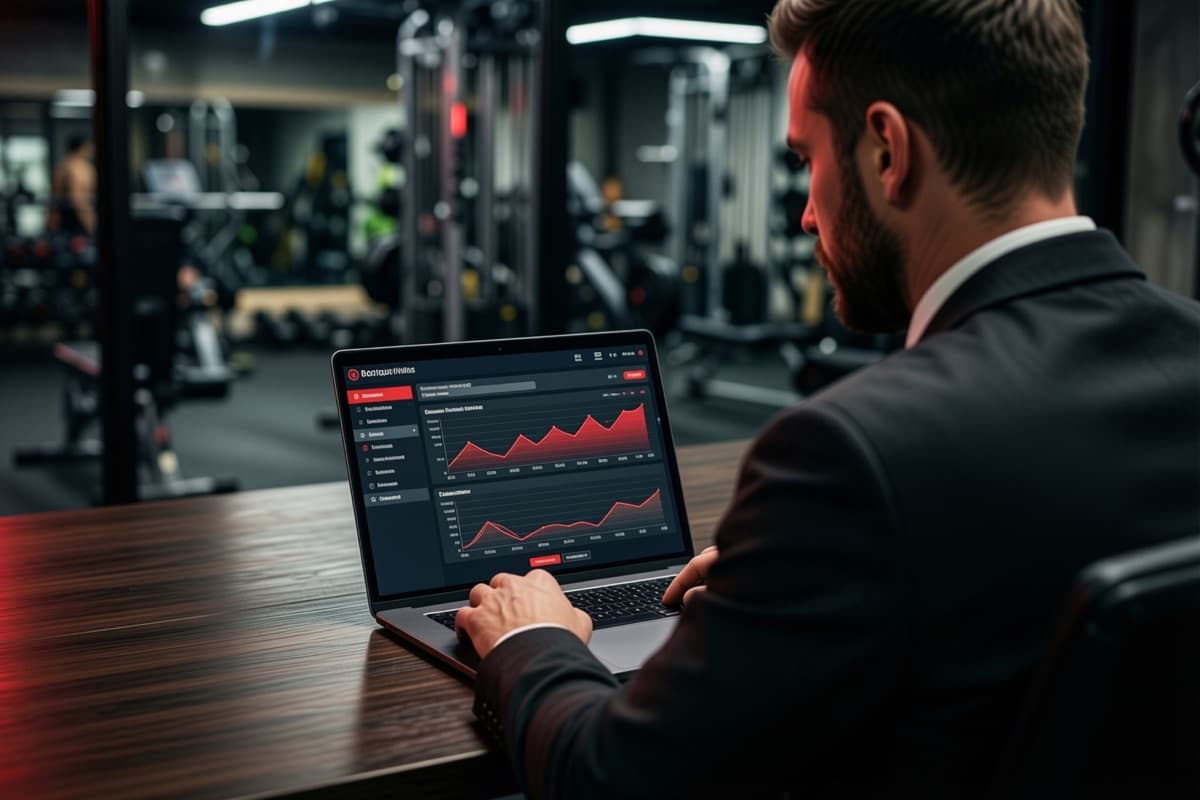
EloByku brings the class schedule together with membership and package sales and billing in a single dashboard. A trainer sees today's and next week's room occupancy, a client books a slot from their phone, and membership payments settle automatically - no manual chasing of who has already paid.
There is also one formality EloByku takes off your plate from day one: during onboarding, you just enter your studio's tax ID (NIP), and the system pulls the company details straight from the Polish Ministry of Finance's white list of taxpayers - name, address, bank account number. No retyping, and no risk of a typo that breaks an invoice later.
Under many sanitary-inspection notification procedures, the authority has up to 14 days just to schedule an inspection - the one step in the paperwork that no amount of good organization can speed up.
Summary
Opening a training or EMS studio in Poland runs along several parallel tracks: business form and business codes, the sanitary inspection, music licensing and the cash register, plus liability insurance that, while optional, protects you the first time a client gets seriously hurt. None of these steps is complicated on its own - the challenge is sequencing them and the time some of them take, especially waiting on the sanitary inspection.
Start the paperwork earlier than you think you need to, and hand the operational side of the studio - scheduling, memberships, payments - to a tool that grows with you. Check EloByku's pricing and see what opening an EMS studio in Poland actually costs in our earlier guide.
This article is not legal or tax advice. It reflects the situation as of August 2026 - sanitary requirements, official interpretations, and local rules vary between counties, so confirm every step with your local PSSE and an accountant or lawyer before opening your studio.
Running an EMS studio? See EMS studio management software by EloByku — device-slot scheduling, session packages and trainer payroll in one system.