GLP-1 and semaglutide: what every trainer should know

You're sitting at your desk reviewing next week's schedule. The phone rings. A client you've been working with for six months tells you she started taking Ozempic. She asks whether she should change her training. You don't know what to say. You're not alone — more and more personal trainers are facing the same question.
GLP-1 receptor agonist medications, primarily semaglutide, have reshaped the global health and weight loss market. In 2025 alone, Novo Nordisk sold over 25 billion dollars worth of semaglutide. In Poland, the number of prescriptions for this drug class has tripled in the past two years. Your clients know about it. The question is not whether you'll encounter the GLP-1 topic in your work. The question is when.
This article gives you a solid foundation. It explains what GLP-1 is, how semaglutide works, and what it means for your daily work with clients. We won't judge whether anyone should take the drug — that's a decision between the patient and their doctor. We'll focus on what you as a trainer need to know to properly support a client who is already on it.
What is GLP-1 and why it matters
GLP-1 stands for glucagon-like peptide-1. It is an incretin hormone — part of a group of substances your body produces in the gut in response to food. L-cells in the small intestine secrete GLP-1 within minutes of eating. It is one of the key signals that tells the body: I just received fuel.
This hormone plays several roles. First, GLP-1 stimulates the pancreas to release insulin. But it does so intelligently — only when blood glucose levels are elevated. Second, it suppresses glucagon, a hormone that raises blood sugar. Together, these two mechanisms help maintain stable blood glucose after a meal. That's why semaglutide was originally developed as a type 2 diabetes drug — before its weight loss potential was discovered.
But GLP-1 does something else. It slows gastric emptying, keeping food in the digestive tract longer. The effect is simple: you feel full for longer. Additionally, GLP-1 acts directly on the hypothalamus — the brain center responsible for appetite regulation. It sends a signal: "you've had enough, stop eating." This isn't about willpower — it's biochemistry. The hormone literally changes how the brain processes hunger and satiety information.
The problem is that native GLP-1 has a very short half-life. The body breaks it down within 2-3 minutes via the enzyme DPP-4. This means the natural hormone works like a brief pulse — it appears after a meal and quickly disappears. For a healthy person, that's sufficient. For someone with insulin resistance or obesity, it often isn't. Their incretin system may function less efficiently, leading to weaker appetite and blood sugar regulation.
How semaglutide works
Semaglutide is a synthetic analog of GLP-1. Its structure is 94% identical to human GLP-1, but that 6% difference changes everything. Key chemical modifications make semaglutide resistant to DPP-4 breakdown and allow it to bind to albumin in the blood. The result: a half-life of approximately 165 hours, or nearly 7 days. For comparison: native GLP-1 lives 2-3 minutes. Semaglutide lives thousands of times longer.
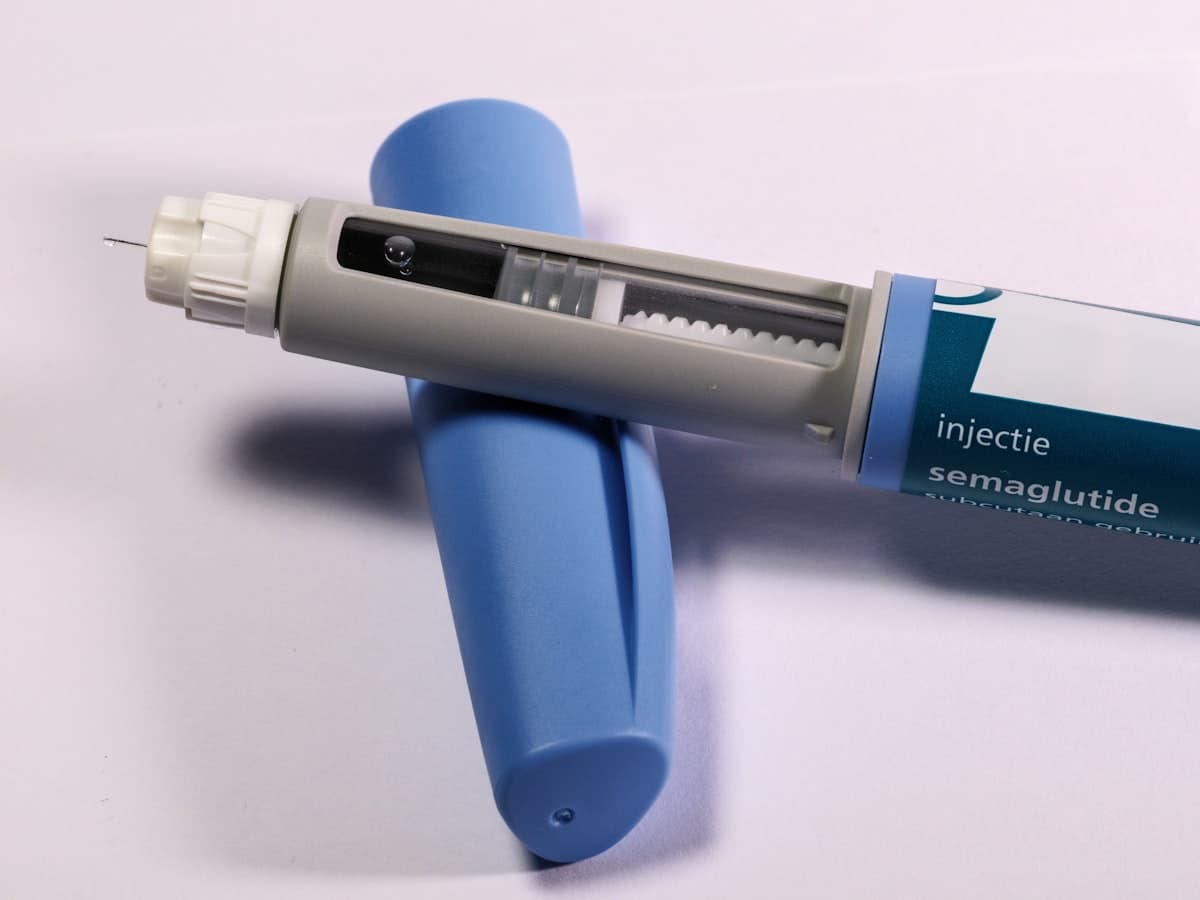
That's why patients take semaglutide once a week — as a subcutaneous injection (Ozempic, Wegovy) or daily as a tablet (Rybelsus). Throughout the week, the drug maintains steady levels in the body and continuously activates GLP-1 receptors. Ozempic is approved for type 2 diabetes treatment, Wegovy for obesity treatment. The active substance is the same. The dose and indication differ.
The mechanism of action involves three main pathways. The first is delayed gastric emptying. Food stays in the stomach longer, extending post-meal satiety. Studies show semaglutide delays gastric emptying by 30-40% compared to placebo. In practice, a client feels full for 4-6 hours after a normal portion instead of 2-3.
The second pathway is action on the hunger center in the hypothalamus. Semaglutide crosses the blood-brain barrier and activates POMC/CART neurons that suppress appetite. At the same time, it inhibits NPY/AgRP neurons responsible for hunger signals. Clients on semaglutide describe this as "I just don't think about food." It also reduces a phenomenon called food noise — the intrusive thoughts about eating that many people with obesity experience.
The third pathway is blood glucose regulation. Semaglutide enhances glucose-dependent insulin secretion and suppresses glucagon. This stabilizes blood sugar levels and reduces energy fluctuations throughout the day. For your clients, this means fewer sudden energy drops and less need for snacking between meals.
Impact on body weight: what the numbers say
The most important data on semaglutide and weight loss comes from the STEP clinical trial program (Semaglutide Treatment Effect in People with Obesity). This is a series of four large, randomized, double-blind studies. Together they enrolled over 4,500 participants across four continents.
In STEP 1, which enrolled 1,961 adults with obesity or overweight (without type 2 diabetes), participants received semaglutide 2.4 mg once weekly or placebo. Both groups also followed a reduced-calorie diet with increased physical activity.
In the STEP 1 trial, participants on semaglutide lost an average of 14.9% of their body weight over 68 weeks — more than 5 times the placebo group (2.4%).
These numbers deserve context. A typical diet-and-exercise intervention without medication yields an average of 3-5% weight loss over one year. Semaglutide tripled that result. Over one-third of participants lost at least 20% of their body weight.
STEP 3 went further. It combined semaglutide with intensive behavioral intervention (30 dietary counseling sessions in the first year). The result: average weight loss was 16.0% in the semaglutide group vs. 5.7% in the placebo group. This shows that medication and lifestyle change together work more powerfully than either alone. For a trainer, this is an argument for active collaboration with the client — the drug alone is not enough.
STEP 4 answered the question of what happens after stopping the drug. Participants who switched from semaglutide to placebo after 20 weeks regained two-thirds of their lost weight over the following 48 weeks. Those who continued the drug lost an additional 7.9% of body weight. The conclusion is clear: semaglutide works, but it requires continuation. It's not a one-time treatment.
It's also worth knowing about the plateau effect. Weight loss on semaglutide is not linear. The most intense decline occurs between months 3-6, then the pace slows. Around week 60, body weight stabilizes. For a trainer, this is key information: a client who has "stopped losing weight" isn't necessarily doing something wrong. The plateau is a normal part of the process — and a good moment to focus on body recomposition rather than the scale.
What trainers need to know about clients on GLP-1
Before we get into practice — a clear disclaimer. As a trainer, you don't prescribe medications, modify doses, or advise on pharmacological matters. Your role is to adjust training and support clients within your scope of competence. Knowledge of GLP-1 helps you better understand what your client is going through — and respond appropriately.
Protein deficiency is a real risk. Semaglutide dramatically reduces appetite. Many clients spontaneously cut their daily caloric intake by 30-40%. The problem is that the reduction affects all macronutrients — including protein. STEP studies show that approximately 40% of lost body weight is lean mass (muscle, bone, water). Without adequate protein (minimum 1.2-1.6 g per kg of target body weight), clients lose muscle faster than they should. Talk to your client about prioritizing protein at every meal — this is one of the most important actions you can take.
Resistance training becomes a priority. If your client on GLP-1 previously focused mainly on cardio, it's time for a change. Strength training is the most effective tool for preserving muscle mass during weight loss. A study published in JAMA Internal Medicine in 2024 found that individuals combining semaglutide with resistance training 3 times per week lost 20% less muscle mass than the group without strength training. Progressive overload remains key. The muscle needs a signal to maintain volume — even in caloric deficit conditions.
Hydration requires attention. Semaglutide slows gastric emptying and can cause nausea, especially in the first weeks of use. About 20% of patients experience nausea, and 8-10% experience vomiting. This directly affects hydration. Make sure your client drinks enough water — especially on training days. Small, frequent sips work better than large amounts at once.
Energy levels can be unpredictable. Clients on semaglutide eat significantly less. In the first weeks, before the body adapts, they may feel fatigued and experience energy drops during training. Monitor session intensity. Be ready to reduce training volume by 20-30% during the adaptation phase, which typically lasts 4-8 weeks. After that period, most clients return to normal performance levels.
Gastrointestinal effects affect session planning. Clients may report bloating, diarrhea, or constipation — especially in the days right after injection. Ask which day of the week your client takes the medication. Many trainers avoid scheduling intense sessions for 24-48 hours after injection, when side effects tend to be strongest.
Here is a practical checklist for trainers working with clients on GLP-1:
- Ask the client about their current dose and treatment phase (dosage increases gradually over 16-20 weeks)
- Monitor protein intake — it should be at least 1.2 g/kg of target body weight daily
- Include resistance training at least 2-3 times per week with progressive overload
- Track hydration, especially if the client reports nausea
- Adjust training volume and intensity to the client's energy levels
- Avoid intense sessions on injection day and the day after
- Measure body composition (not just weight) every 4-6 weeks to track the fat-to-muscle ratio
- Communicate with the client's dietitian, if one is part of the team
Summary
GLP-1 and semaglutide are not a passing trend. This is a change that will stay in the fitness industry for years. According to Goldman Sachs projections, by 2030 as many as 15% of American adults may be using GLP-1 medications. Europe, including Poland, is following the same path with a 2-3 year delay. New molecules are already on the horizon — tirzepatide (a dual GIP/GLP-1 agonist) and survodutide (a triple agonist) — which may be even more effective.
As a trainer, you don't need to be a pharmacology expert. But you do need to understand how these drugs affect your clients' bodies and behavior. A client on semaglutide needs a trainer who knows that the priorities are preserving muscle mass, adequate protein intake, and matched training intensity.
The knowledge you're gaining today allows you to lead conversations from a position of competence. You don't need to advise on medications. But when a client says "I'm on Ozempic," you can respond: "I understand, let's adjust your training plan." That builds trust. And trust builds long-term client relationships.